

Location — Seneca, Missouri
The Hornet Spook Light
A ball of fire that has drifted the same stretch of road for over a century. No explanation has ever held.
On a gravel road in the far southwestern corner of Missouri, just outside the town of Seneca and a few miles from the Oklahoma border, something has been appearing in the dark for more than a hundred years. Locals call it the Spook Light. The road it travels has been called the Devil's Promenade. Neither name was chosen lightly.
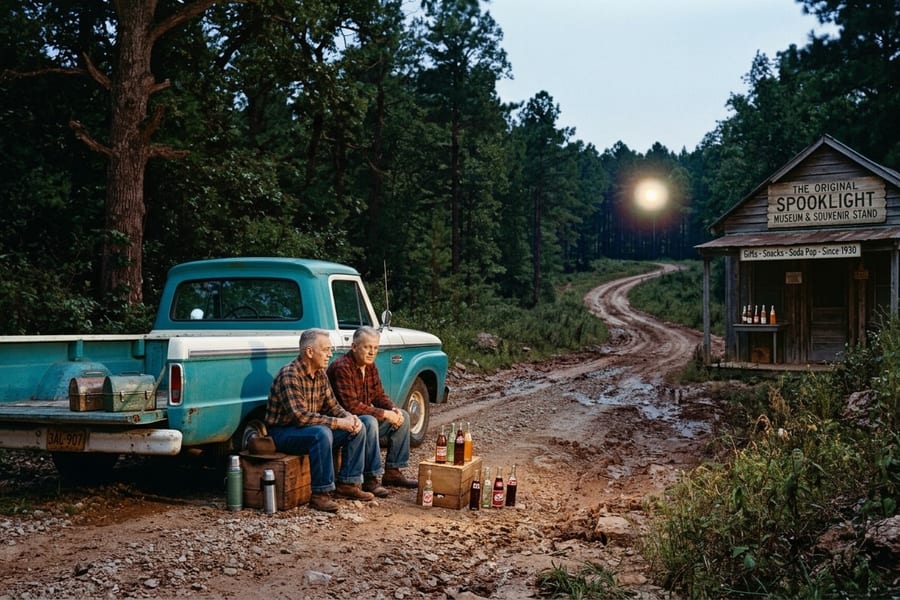
The light appears as a glowing sphere, typically orange or amber, sometimes shifting toward white or pale yellow. It hovers at roughly head height above the road, moving with a slow, deliberate drift before accelerating, splitting, or vanishing entirely. Witnesses who have stood on that road and watched it approach describe a sensation that is difficult to articulate — not quite fear, not quite wonder, but something that sits between the two and does not resolve.
History
A Record That Begins Before Living Memory
The earliest written accounts of the Hornet Spook Light date to the 1880s, when settlers in the Ozarks began documenting a strange light along the road between Hornet, Missouri and the Oklahoma border. The light was not new to the region's Indigenous inhabitants — the Quapaw and Osage peoples had accounts of a spirit light in the area that predate European settlement, though the precise relationship between those accounts and the modern phenomenon is not documented with certainty.
By the early twentieth century, the light had become well enough known that it attracted visitors from outside the region. During World War II, the U.S. Army Corps of Engineers sent a team to investigate. Their conclusion, after several nights of observation, was that the light was real, that it was not a hoax or a reflection, and that they could not explain it. The report was filed and the investigation closed without a finding.
The 1940s and 1950s brought a wave of popular attention. Ripley's Believe It or Not featured the Spook Light. Newspapers across the Midwest ran accounts from witnesses. A small museum opened near the road to serve the tourists who came to see it. The museum is gone now, but the light remains.
It came down the road toward us, slow and steady, about the size of a basketball. We all got out of the car. It stopped maybe thirty feet away and just hung there, pulsing. Then it was gone.
— Witness account, Devil's Promenade, 2019
Theories
What Has Been Proposed
Swamp Gas
The most common dismissal. The terrain around the Devil's Promenade is not swampy, and swamp gas does not hover at consistent heights, accelerate, or split into multiple spheres. The theory has been applied and discarded by multiple investigators.
Headlight Refraction
A persistent explanation: that the light is a refraction of automobile headlights from Route 66 or Highway 66, bent by atmospheric conditions over the flat terrain. The problem is that accounts of the light predate the automobile by several decades, and witnesses report the light on nights when no traffic is present on the relevant roads.
Ball Lightning
Ball lightning is a documented atmospheric phenomenon, but it is rare, short-lived, and associated with thunderstorm activity. The Spook Light appears on clear nights, in dry weather, and has been observed continuously for over a century. Ball lightning does not behave this way.
Piezoelectric Effect
Some researchers have proposed that stress on the quartz-bearing rock formations beneath the Ozarks generates electrical discharge that manifests as light. This theory is taken more seriously than most — piezoelectric effects are real and documented — but no direct connection to the Spook Light has been established.
Legend
The Stories That Attached Themselves
No phenomenon of this duration accumulates without stories. The Spook Light has several. The most widely repeated involves a miner who lost his head in an accident and now carries a lantern through the dark searching for it. A variant replaces the miner with a Quapaw chief searching for his children, taken by settlers. Another tells of a young couple separated by war, their lanterns still swinging as they search for each other across the dark.
These stories are not the phenomenon. They are what people reach for when something resists explanation — a narrative frame to hold what cannot otherwise be held. The light was here before the stories, and it has outlasted every attempt to contain it in one.
Witness Accounts
What Witnesses Report
Accounts from the last several decades are consistent with those from the nineteenth century. The light appears most often after dark, typically between nine in the evening and two in the morning. It is most frequently observed from the eastern end of the road, looking west. It approaches, hovers, retreats. On some nights it does not appear at all.
Witnesses who have attempted to approach it on foot report that it recedes as they advance, maintaining distance. Those who have driven toward it report the same. Several accounts describe the light entering vehicles — passing through a windshield and moving through the interior of a car before exiting through the rear window. These accounts are outliers, but they recur across different witnesses and different decades.
What is not in dispute: the light is real. It has been photographed, filmed, and observed by thousands of people over more than a century. Whatever it is, it is there.
Visiting
Finding the Devil's Promenade
The road is located approximately twelve miles southwest of Joplin, Missouri, near the town of Seneca. The specific stretch associated with the light runs along what locals call the Devil's Promenade — a section of gravel road near the Oklahoma state line in Newton County. The road is accessible by car and is on public land.
There are no facilities, no lighting, and no markers. You park at the side of the road, face west, and wait. The best conditions are clear nights with no moon. The light does not appear on a schedule. Some visitors see it within minutes. Others wait for hours and see nothing. A small number return multiple times before they see it, and a smaller number never do.
Field Notes
Contribute to the Index
Share Your Account
Have you witnessed the Spook Light? Your account becomes part of the documented record.